
 Track Your Shipment
 Online Enquiry
 Sign In
 English
 Alfares Cargo
 Logistic Informations
 2026-04-19
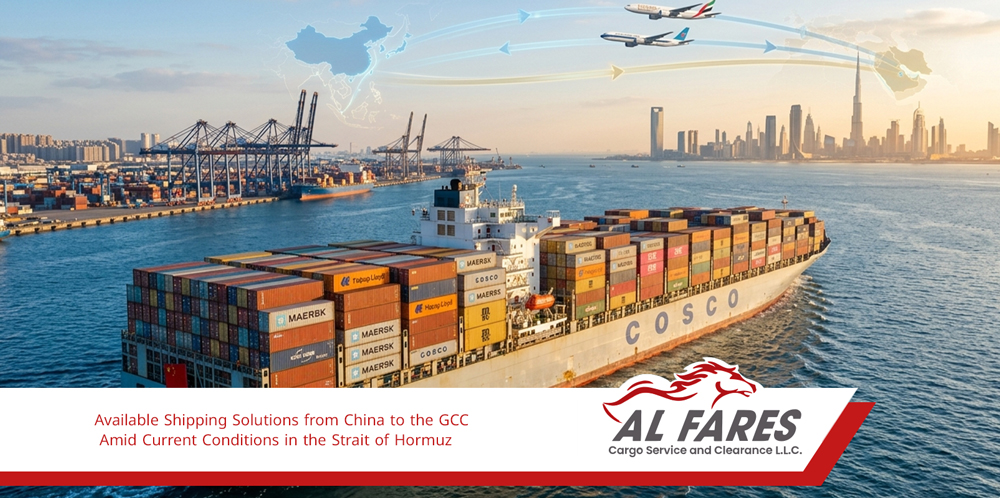
The current period marks one of the most sensitive phases in trade between China and the Gulf Cooperation Council (GCC) countries, driven by escalating tensions in the Strait of Hormuz one of the world’s most critical maritime chokepoints. A significant portion of global energy trade, along with containerized cargo from East Asia particularly China passes through this narrow passage toward major ports in Saudi Arabia, the UAE, Kuwait, Qatar, Bahrain, and Oman.
With rising security concerns in the surrounding maritime region, direct impacts on global supply chains have become increasingly evident especially those connecting China with the GCC. As a result, global shipping lines, logistics providers, and importers across the Gulf have begun actively seeking alternative routes and flexible solutions to ensure uninterrupted cargo flow.
These tensions have led to a sharp increase in marine insurance premiums, longer transit times, and elevated operational risks forcing some carriers to suspend services through the Strait or redesign their routes entirely.
Current Challenges of Maritime Shipping via the Strait of Hormuz
Maritime shipping via the Strait of Hormuz has become significantly more complex and risk-sensitive. The region is currently experiencing unprecedented instability, which is directly affecting supply chain efficiency and cost structures.
1. Surge in Marine Insurance Costs
One of the most critical challenges is the substantial increase in marine insurance premiums. Insurance providers have raised rates due to heightened security risks, in some cases reaching three to four times the usual cost. This directly impacts final freight rates, particularly for low-margin goods such as raw materials and heavy cargo.
2. Increased Security Risks
In 2026, potential threats include vessel interception, targeted attacks, or instability-related incidents near the Strait. Several shipping lines have already reduced vessel frequency or rerouted entirely, forcing ships to travel longer distances or increase speed—resulting in higher fuel consumption and operational costs.
3. Maritime Congestion
With limited safe passage routes and heightened caution, congestion has increased significantly. This leads to:
- Delays in port entry
- Longer waiting times
- Disruptions in cargo handling operations
GCC ports are now experiencing irregular vessel arrival schedules, complicating logistics planning.
4. Route Diversions by Shipping Lines
Many global carriers have restructured their routes by:
- Diverting vessels toward the Arabian Sea
- Offloading cargo at alternative ports outside the Strait
- Using feeder vessels to distribute cargo within the GCC
While effective, this adds an extra logistics layer, increasing both cost and risk of cargo handling damage.
5. Volatility in Global Freight Rates
The Strait tensions have coincided with global freight rate increases due to vessel demand and rising fuel prices. Container shipping costs from China to the GCC have significantly surged compared to previous years.
6. Declining Confidence Among Importers
Importers in the GCC are increasingly reluctant to rely solely on routes via the Strait. This has led to:
- Supply rescheduling
- Adoption of alternative logistics strategies
- Increased reliance on intermediate hubs outside the Gulf
Maritime Solutions to Bypass or Mitigate Risks
To adapt, logistics providers and importers are now leveraging alternative maritime strategies:
1. Alternative Routes via the Arabian Sea
Shipping lines are redirecting vessels toward safer ports outside high-risk zones before redistributing cargo within the GCC. This reduces:
- Exposure to high-risk areas
- Insurance costs
- Port congestion delays
The Arabian Sea has become a relatively safer staging area for cargo consolidation.
2. Offloading at Safe Ports Outside the Strait
Several key ports in Oman and the region have emerged as secure alternatives:
- Salalah Port: A major deep-sea hub strategically located along global shipping lanes
- Duqm Port: A modern logistics hub with advanced infrastructure and storage capabilities
- Sohar Port: Ideal for fast distribution to the UAE and nearby markets
- Jeddah Port: A strategic Red Sea gateway enabling access to GCC markets
These ports now function as safe consolidation hubs for cargo arriving from China.
3. Sea–Land (Multimodal) Shipping Model
One of the most effective solutions today:
- Ship containers from China to Oman
- Transport cargo via trucks or rail into GCC countries
Popular routes include:
- Duqm → Riyadh via Oman and Saudi Arabia
- Sohar → Dubai or Abu Dhabi within hours
Advantages:
- Faster than waiting for Strait clearance
- More cost-effective than air freight
- High reliability
4. Temporary Storage in Free Zones
Companies are increasingly using:
- Jebel Ali Free Zone (UAE)
- Salalah Free Zone (Oman)
Along with bonded warehouses to:
- Store inventory
- Enable flexible distribution
- Reduce urgency for expedited shipping
To read more about sea frieght click here.
Air Freight Solutions to Compensate for Maritime Delays
With ongoing disruptions, air freight has become a strategic alternative especially for high-value or time-sensitive goods.
1. Direct Air Freight from China to GCC Airports
Major destinations include:
UAE:
- Dubai International Airport
- Al Maktoum International Airport (DWC)
- Abu Dhabi International Airport
Saudi Arabia:
- Riyadh (King Khalid Airport)
- Jeddah (King Abdulaziz Airport)
- Dammam (King Fahd Airport)
Others:
- Doha (Hamad International Airport)
- Kuwait, Bahrain, and Oman airports
Advantages:
- Fast delivery
- Real-time tracking
- Ideal for urgent shipments
2. Charter Flights
Due to capacity pressure, companies increasingly rely on full cargo charter flights to:
- Secure large shipment volumes
- Reduce dependency on maritime routes
- Meet seasonal demand (Ramadan, back-to-school, etc.)
3. Air–Land Hybrid Model
A highly efficient solution combining speed and cost optimization:
- Air freight to UAE, Oman, or Saudi Arabia
- Land transport to final GCC destinations
Benefits:
- Lower cost than full air freight
- Faster than sea freight
- Ideal for medium-value goods (electronics, apparel)
Dubai and Muscat are leading hubs for this model.
4. Expansion of GCC Air Freight Networks
Airlines in the region have responded by:
- Increasing flight frequencies
- Expanding cargo capacity
- Deploying dedicated freight fleets
5. Air Freight Hubs
Key logistics hubs include:
- Dubai South Free Zone
- Duqm Special Economic Zone
- Hamad Airport Free Zone
These hubs provide:
- Temporary storage
- Cargo sorting
- Rapid redistribution
6. Adoption of Multi-Route Supply Chain Strategies
Air freight is no longer just a backup it is now part of a broader logistics strategy. Companies are adopting hybrid models combining:
- Direct air freight
- Alternative sea routes
- Sea–Air solutions
- Land transport from intermediate hubs
This ensures operational continuity and reduces dependency on any single route.
to read more about air frieght click here.