
 Track Your Shipment
 Online Enquiry
 Sign In
 English
 Alfares Cargo
 Logistic Informations
 2026-04-21
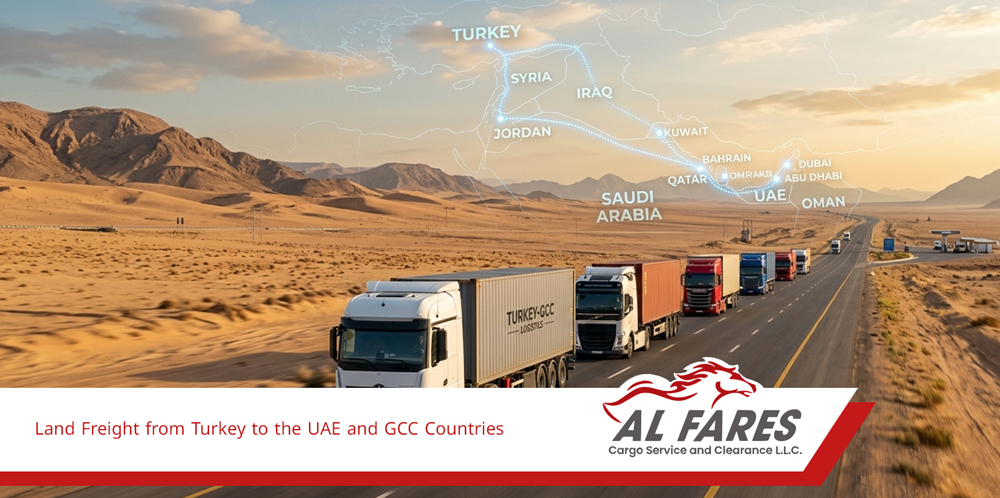
In recent times, supply chain priorities between Turkey, the UAE, and the GCC have undergone a noticeable shift. Land freight is no longer just an alternative to sea or air shipping it has become one of the most strategic routes for regional trade. This shift is driven by a combination of economic, geopolitical, and logistical factors that have elevated the importance of road transport.
The Impact of Current Regional Conditions on Land Freight
One of the main reasons behind the rise of land freight is the ongoing uncertainty surrounding key maritime routes, particularly the Red Sea and the Strait of Hormuz—two of the most sensitive corridors for Gulf trade. Recent regional tensions have increased caution in sea shipping and pushed many importers to seek alternatives that reduce the risks of delays or sudden route changes.
In this context, land freight has emerged as a practical solution because it:
- Is less affected by maritime disruptions
- Offers greater flexibility in rerouting shipments
- Enables direct delivery to warehouses and distribution centers
- Reduces dependency on port schedules and vessel availability
Main Land Freight Routes from Turkey to the UAE & GCC
Land freight from Turkey to the Gulf is no longer dependent on a single fixed route. Logistics companies now rely on multiple corridors and multimodal solutions depending on security conditions, clearance speed, cargo type, and border status.
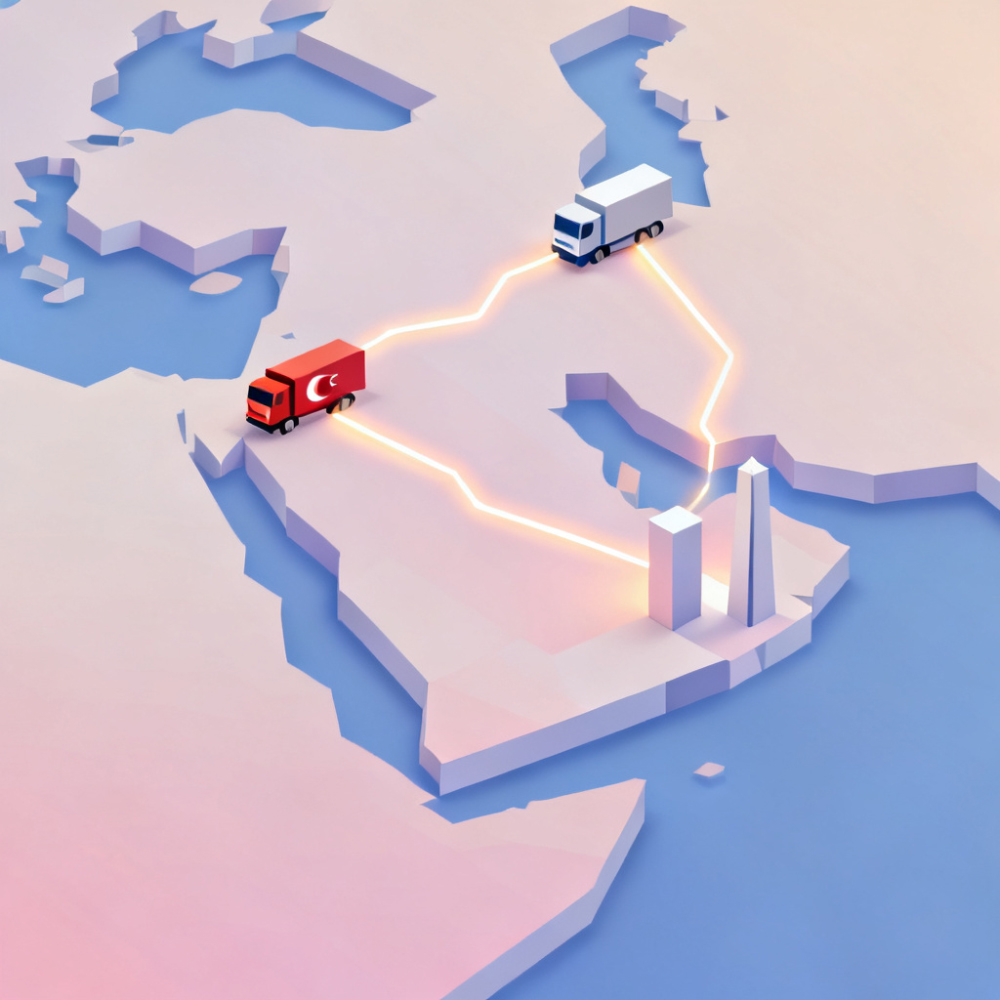
Following recent regional developments, three major routes have become the most commonly used for transporting goods from Turkey to the UAE and other GCC countries.
Turkey – Syria – Jordan – Saudi Arabia – UAE Route
This route represents one of the most significant logistical developments today, especially after the reactivation of the “Middle East Corridor,” which connects Turkey directly to Jordan and the GCC through Syria. Official Turkish statements indicate that this route became fully operational in 2026, with transit times expected to drop to less than one week.
Route Path:
Turkey → Syria → Jordan → Saudi Arabia → UAE
From the UAE, goods can be redistributed to:
Oman, Qatar, Bahrain, and Kuwait
Why is this route important?
- Shorter distance compared to maritime routes
- Cost reduction of up to 30–40%
- Ideal for fast commercial shipments
- Reduces pressure on Iraqi border crossings
- Suitable for furniture, textiles, and food products
Best Use Cases
This route is highly suitable for:
- Full Truck Load (FTL) shipments
- Less than Truck Load (LTL) shipments
- Seasonal goods
- Hotel and real estate projects
- B2B e-commerce supply chains
How to Choose the Best Route
Choosing the right route is no longer just about distance. It depends on several key factors, including:
- Daily border conditions
- Customs clearance speed
- Type of cargo
- Insurance requirements
- Transit fees
- Availability of refrigerated trucks
- Final delivery point within the GCC
This is why professional logistics providers now rely on dynamic route planning rather than fixed routes.
Land Freight Process from Turkey to the UAE & GCC
The land freight process from Turkey to the UAE and GCC countries is a fully integrated logistics operation that involves several stages, starting from cargo pickup and ending with final delivery.
1. Cargo Pickup from Supplier in Turkey
The process begins with coordinating with the supplier to prepare the goods, including packaging, inspection, and documentation. The shipment is then collected from the factory or warehouse and transported to a consolidation point or loaded directly onto a truck for full shipments.
2. Consolidation or Direct Loading
For LTL shipments, goods are transported to a consolidation warehouse where multiple shipments are combined into one truck to reduce costs. For FTL shipments, goods are loaded directly onto a dedicated truck. Cargo is secured properly for long-distance transport.
3. Documentation & Permits
Before departure, all required documents are prepared, including:
- Commercial Invoice
- Certificate of Origin
- Packing List
- Bill of Lading
Transit permits are also issued, often under the TIR system, which allows trucks to cross multiple borders without unloading cargo.
4. Transportation via Land Routes
The truck departs from Turkey through one of several available routes, which may pass through countries such as Georgia, Iraq, or Syria and Jordan, depending on logistics conditions and border status.
5. Border Transit Procedures
At each border crossing, shipment documents are presented to customs authorities. In most cases, cargo is not unloaded thanks to transit systems. Documents are stamped, and trucks proceed after inspections or electronic verification.
6. Arrival in the UAE or GCC Country
Upon arrival, the shipment is directed to the relevant customs entry point. If intended for local markets, customs clearance procedures begin. If for re-export, the shipment may be transferred to a bonded warehouse without paying duties.
7. Customs Clearance & Final Delivery
This stage includes document verification, duty assessment, and cargo inspection if required. Once cleared, the shipment is delivered to the client’s warehouse or project site. In some cases, goods are redistributed to other GCC countries.
To read Why Al-Fares in Customs Clearance? click here.
8. Shipment Tracking & Management
Throughout the journey, shipments are tracked using advanced systems that provide real-time updates on truck location and estimated arrival time, along with continuous communication with clients.
How to Choose the Best Land Freight Company
Choosing a land freight company today is no longer based solely on price or transit time. It has become a strategic decision linked to supply chain stability, flexibility, and operational efficiency.
1. Strong Operational Presence
The most important factor is having a real operational network in Turkey and GCC countries like Saudi Arabia and the UAE. This reduces delays and minimizes risks associated with truck changes and border issues.
Al Fares Cargo stands out with its strong presence and network of branches and agents across these regions.
2. Specialized Experience in Turkey–GCC Trade
Not all logistics providers are equipped to handle this route efficiently. The ideal partner should have deep knowledge of Turkish suppliers, warehouse operations, and common cargo types.
Al Fares demonstrates this expertise by offering tailored services for both FTL and LTL shipments, including consolidation solutions.
3. Diverse Fleet Capabilities
A strong logistics company must have a diverse fleet capable of handling different cargo types—full loads, partial loads, refrigerated goods, and heavy shipments.
Al Fares offers a versatile fleet serving industries such as furniture, construction materials, food products, and hospitality projects.
4. Fast Transit & Route Flexibility
With constantly changing regional conditions, the ability to adapt quickly and select the best routes is critical.
Al Fares focuses on minimizing transit time by actively monitoring routes and selecting the fastest available options.
5. Integrated Logistics Services
Leading companies provide end-to-end solutions, including transportation, customs clearance, warehousing, and redistribution.
Al Fares excels in this area by offering seamless logistics solutions, enabling shipments to arrive in Dubai, Sharjah, or Abu Dhabi and then be redistributed across the GCC.
6. Why Choose Al Fares Cargo?
Al Fares offers a fully integrated logistics ecosystem—from supplier pickup in Turkey to final delivery and redistribution in the GCC. This makes it ideal for industries such as:
- Furniture trading
- Construction materials
- Fashion & textiles
- Hospitality projects
- E-commerce and restaurant supply chains
7. When is Al Fares the Ideal Choice?
Al Fares is the perfect choice when shipments require:
- Direct pickup from multiple suppliers in Turkey
- Consolidation of goods
- Delivery to the UAE with redistribution across GCC countries
- Fast customs clearance
- Temporary storage or continuous shipping operations
It is especially valuable for businesses relying on regular supply chains or long-term projects that require a reliable logistics partner.