
 Track Your Shipment
 Online Enquiry
 Sign In
 English
 Alfares Cargo
 Logistic Informations
 2026-05-14
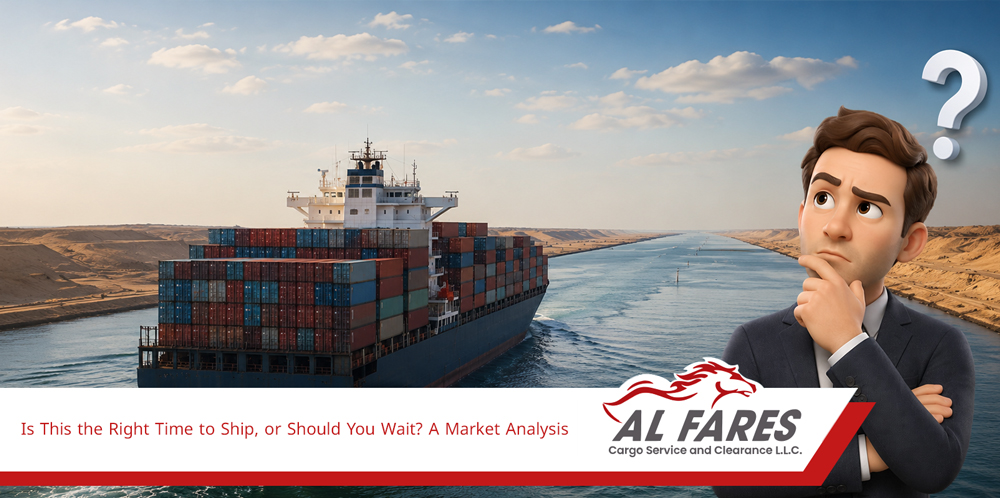
The global shipping industry is currently facing rapidly evolving challenges, including disruptions in Red Sea navigation, fluctuations in global oil prices, rising marine insurance costs, and increasing pressure on global supply chains. These factors have left importers and traders asking a critical question: Is now the right time to ship before further price increases occur, or would waiting be the safer option?
Amid this unstable environment, the importance of working with a logistics company that possesses real expertise in managing shipping operations during uncertain periods has become more evident than ever. This is where Al Fares Cargo Service & Clearance stands out by continuously monitoring global market developments and helping clients choose the most suitable shipping solutions in terms of cost, speed, and security.
Having a logistics partner capable of understanding and analyzing market conditions is no longer a luxury it has become an essential factor in reducing risks and ensuring business continuity.
As global economic and political conditions continue to shift, making smart shipping decisions is no longer simply about finding the cheapest freight rate. Instead, it is about selecting the right timing, the safest route, and the logistics strategy that can best adapt to unexpected developments in the global market.
The Current Global Situation: Why Has the Shipping Market Become Unstable?
The global shipping sector is currently experiencing unprecedented volatility due to the overlap of political, economic, and security-related challenges happening simultaneously. These developments have made global trade more sensitive to sudden changes, forcing importers and exporters to closely monitor market conditions before making shipping decisions.
Below are the key factors driving the current instability in the global shipping market:
A) The Red Sea and Strait of Hormuz Crisis
The Red Sea and the Strait of Hormuz are among the world’s most important trade corridors, through which a significant percentage of oil and cargo shipments move between Asia, Europe, and the Gulf countries. With escalating military and security tensions in the region during recent months, many international shipping lines have started reassessing their maritime routes to minimize potential risks.
This situation has resulted in several direct impacts on the global shipping market, including:
- Some vessels avoid transit through the Red Sea.
- Rerouting ships through longer maritime paths, such as around the Cape of Good Hope.
- Increased transit times by several days or even weeks on certain routes.
- Rising fuel and operational costs due to longer sailing distances.
- Additional security-related surcharges and marine insurance fees.
Under these circumstances, logistics companies that can offer flexible alternative routes are better positioned to minimize the impact of the crisis on customers. This is exactly what Al Fares Cargo Service & Clearance provides through multiple shipping options tailored to current market conditions while helping clients maintain cargo movement with minimal delays.
B) Rising Oil and Energy Prices
Oil prices are among the most influential factors affecting all modes of transportation, including sea freight, air freight, and land transportation. Any increase in energy prices directly raises operational costs for transport companies, which is eventually reflected in the final freight rates paid by customers.
Recently, global oil markets have experienced significant volatility due to concerns surrounding geopolitical tensions in energy-producing and exporting regions, as well as instability affecting major maritime trade routes. As a result, many shipping companies have imposed additional fuel surcharges to offset rising operational expenses.
When Is Shipping Now a Smart Decision?
Despite the uncertainty dominating global markets, there are situations where immediate shipping becomes the smartest and most profitable option especially when business continuity depends on inventory availability and product delivery speed.
Below are the main scenarios where shipping now can be considered a strategic decision:
A) If Your Goods Are Seasonal
Seasonal products such as seasonal clothing, electronics, school supplies, Ramadan-related products, and holiday merchandise are among the most time-sensitive shipments because their commercial success depends heavily on arriving before peak demand seasons begin.
Even a delay of a few weeks may lead to missing an entire sales season, significantly affecting profits and sales performance.
Key reasons why early shipping is crucial for seasonal goods include:
- Ensuring products arrive before the commercial season starts.
- Avoiding severe congestion at ports and shipping lines during peak periods.
- Reducing the likelihood of delays caused by geopolitical tensions or maritime route changes.
- Maximizing sales opportunities before seasonal discounts begin.
- Maintaining stable inventory levels within local markets.
For this reason, many companies are currently securing cargo bookings early to guarantee space availability and avoid unexpected disruptions that could affect delivery schedules.
B) If You Depend on Fast-Moving Products
Many businesses rely on maintaining continuous product availability in the market, particularly in sectors such as e-commerce, spare parts, consumer goods, and electronics.
In these industries, inventory shortages can become a bigger threat than rising freight costs themselves.
Waiting too long may result in stock depletion, allowing competitors to capture customers while negatively impacting sales and customer trust.
Main reasons why shipping now may be the right choice for fast-moving products include:
- Maintaining uninterrupted product availability.
- Avoiding lost sales caused by stock shortages.
- Minimizing the impact of future freight market fluctuations.
- Supporting operational stability and supply chain continuity.
- Taking advantage of current market demand before conditions become more complicated.
C) If Current Freight Rates Are Acceptable Compared to Future Risks
Many importers believe that waiting may provide an opportunity to obtain lower freight rates. However, today’s markets have become extremely volatile, making such decisions increasingly risky.
Any geopolitical escalation or further increase in oil prices could lead to sharp freight rate increases within a very short period.
As a result, some companies prefer shipping at current rates even if they appear relatively high because they are still less risky than facing significantly higher costs or reduced cargo space availability later.
Indicators that encourage businesses to ship immediately include:
- Ongoing tensions affecting global trade routes.
- Rising global fuel and energy prices.
- Increasing marine insurance and security surcharges.
- Growing pressure on sea and air freight capacities.
- Expectations of stronger demand during upcoming periods.
When Is Waiting a Logical Option?
Although many businesses are accelerating shipments to avoid future disruptions or price increases, waiting may sometimes be the wiser commercial and financial decision.
Below are the main situations where postponing shipments may be justified:
A) If the Shipment Is Not Urgent
If the cargo is not tied to a seasonal sales cycle or immediate market demand, waiting for a short period may provide a better opportunity to monitor freight rate movements before making a shipping decision.
In some cases, temporary price spikes caused by political events or emergency disruptions may stabilize once conditions improve.
B) If There Are Signs of Political De-escalation
Global freight rates are highly influenced by political and security developments, particularly in strategic trade corridors such as the Red Sea, Strait of Hormuz, and the Suez Canal.
Any signs of improved stability or safer maritime conditions may quickly lead to lower transportation costs worldwide.
In some situations, companies choose to delay shipments temporarily if there are expectations of reduced marine insurance fees or the return of shipping lines to their standard routes, which may significantly reduce transportation expenses.
C) If Local Markets Are Experiencing Weak Demand
Sometimes the issue is not related to freight costs alone, but rather to local market conditions themselves.
If market demand is weak or certain sectors are experiencing temporary slowdowns, delaying imports may help businesses avoid excessive inventory accumulation and rising warehousing costs.
Importing large quantities during periods of slow sales activity may freeze working capital for long periods while generating additional storage and operational expenses without immediate financial returns.
Sea Freight or Air Freight: Which Is Safer Right Now?
Although sea freight remains the most used transportation method worldwide, current conditions have increased the importance of air freight for certain sectors.
At the same time, some companies are adopting hybrid logistics solutions that combine multiple transportation methods to reduce risks while balancing speed and cost efficiency.
A) Sea Freight: The Most Economical Yet Most Vulnerable to Crises
Sea freight remains the backbone of global trade, transporting most of the cargo and containers worldwide, particularly large commercial shipments and heavy goods.
Its relatively lower cost compared to air freight makes it the preferred option for businesses importing large volumes.
However, sea freight is also the transportation method most affected by current geopolitical tensions, especially disruptions impacting major maritime corridors such as the Red Sea and Strait of Hormuz.
This is why many businesses rely on logistics providers capable of offering alternative maritime routes and minimizing delays.
To read more about Sea freight click here.
B) Air Freight: Speed and Stability at a Higher Cost
Amid current global uncertainties, many companies have shifted toward air freight as the fastest and relatively more stable solution compared to sea freight, particularly for urgent or sensitive shipments.
Air cargo is less affected by maritime route closures or port congestion, giving businesses greater ability to maintain supply continuity and stable inventory levels.
To read more about air freight click here.
How Does Al Fares Help You Make the Right Decision?
With uncertainty dominating global markets today, businesses increasingly need a logistics partner with deep expertise and the flexibility to adapt quickly to global political and economic developments.
This is where Al Fares Cargo Service & Clearance provides integrated logistics solutions that help clients manage shipping operations more efficiently regardless of market conditions.
A) Market Analysis and Professional Consultation
One of the biggest challenges facing importers and traders today is predicting global shipping market trends.
Changes are happening rapidly due to geopolitical crises, rising energy prices, and supply chain disruptions, forcing businesses to rely on accurate information and continuous market analysis before making decisions related to shipping, warehousing, or import timing.
Al Fares continuously monitors global market developments, helping customers understand the current situation and selecting the most suitable shipping timing according to their cargo type and commercial needs.
Key support services provided by Al Fares include:
- Offering logistics consultations based on current market conditions.
- Helping customers compare different shipping options.
- Explaining the impact of global developments on freight rates and transit times.
- Recommending the most suitable solutions based on cargo type and budget.
- Assisting companies in minimizing operational and commercial risks.
B) Flexible Shipping Routes and Transportation Solutions
During periods of political instability or congestion at ports and airports, flexibility in logistics route management becomes critically important.
Delays in implementing alternative solutions may result in significant losses caused by shipment interruptions or delayed deliveries.
For this reason, Al Fares offers a wide range of sea, air, and land freight solutions while maintaining the flexibility to quickly adapt routes according to global market developments.
C) Reducing Operational Risks and Accelerating Procedures
During unstable periods, logistics errors become far more costly than usual whether due to shipment delays, incomplete documentation, or sudden changes in customs and shipping requirements.
Businesses therefore need a logistics provider capable of managing operations efficiently while minimizing the likelihood of disruptions.
Al Fares offers integrated logistics services that simplify shipping procedures and reduce operational complexities from cargo pickup to final delivery.
Key services that help minimize risks include:
- Continuous shipment tracking.
- Accurate handling of shipping documents and certificates.
- Efficient customs clearance services.
- Direct coordination with carriers, ports, and airports.
- Minimizing delays and unexpected additional charges.
D) Leveraging Al Fares’ Regional and International Network
One of the most important factors that enables logistics companies to manage crises effectively is the strength of their regional and international networks.
Strong partnerships provide greater flexibility and more competitive pricing, even during challenging periods.
Al Fares Cargo Service & Clearance maintains an extensive logistics network that enables the company to provide diverse solutions tailored to various shipment types and destinations.
Key advantages of this network include:
- Access to multiple shipping lines worldwide.
- Competitive pricing despite market volatility.
- Easier coordination between countries and ports.
- Suitable solutions for both commercial and personal shipments.
- Rapid response to sudden global market changes.
To check out Alfares cargo portfolio click here.